Aptivo
Practice interviews that get you placed.
An AI voice-interview platform that turns interview prep into a verified Talent Passport recruiters can trust.
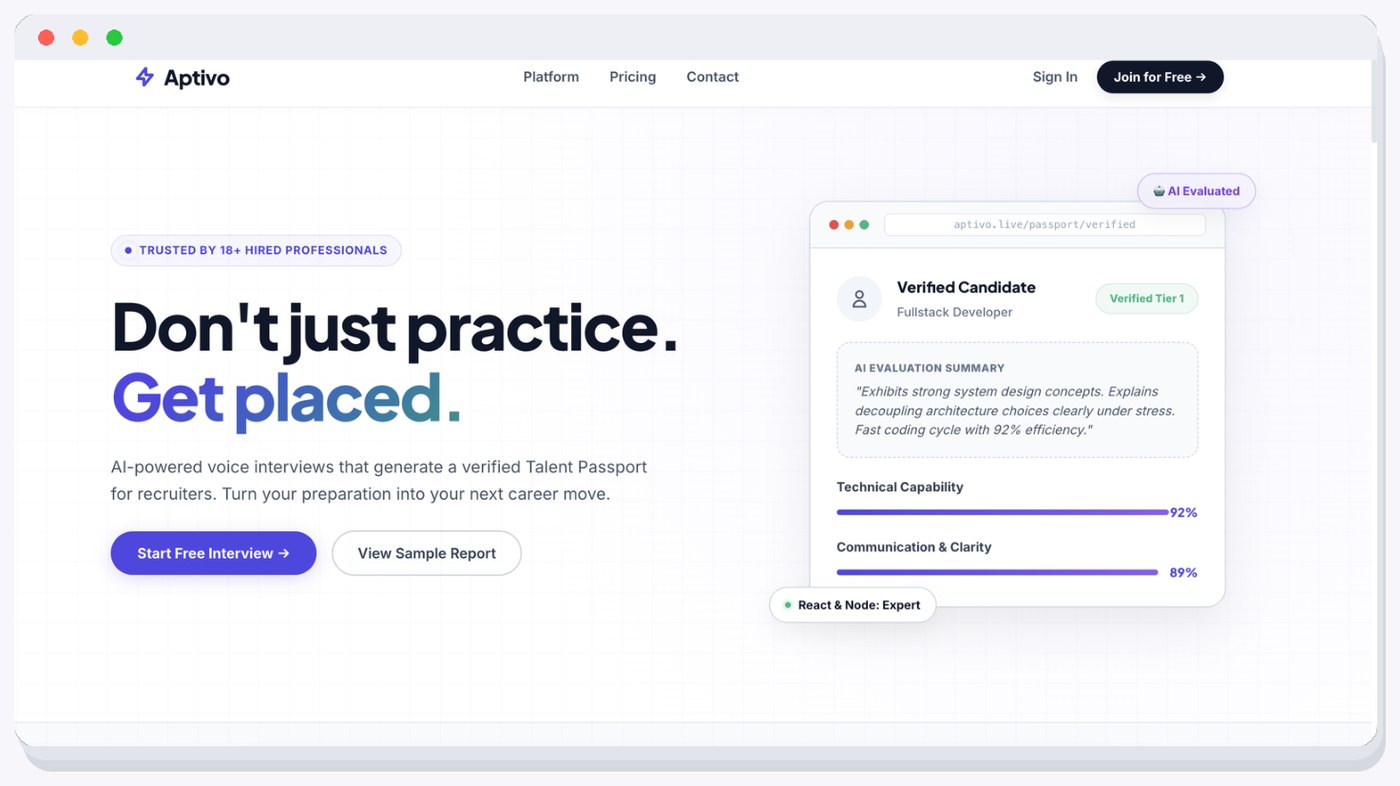
One AI interview, a verified profile.
Aptivo gives job-seekers a real, adaptive voice interview — then turns the result into proof of skill that recruiters can act on.
Founder · Product & UX Designer · Build
Figma · AI-assisted build · Claude AI engine
Live at aptivo.live — early traction
Real AI voice interview
Adaptive questions from your CV and the target role.
Talent Passport
A certified, shareable page of your skills and scores.
Recruiter matching
Verified reports go straight to hiring partners.
Prep doesn’t turn into proof.
Practice and hiring are disconnected. Effort on one side never becomes a signal on the other.
For candidates
- Practice happens in a vacuum.
- No proof they improved.
- CVs blend into the pile.
For recruiters
- Too many look-alike CVs.
- No objective read on skill.
- Early rounds burn time.
Turn the interview itself into the proof.
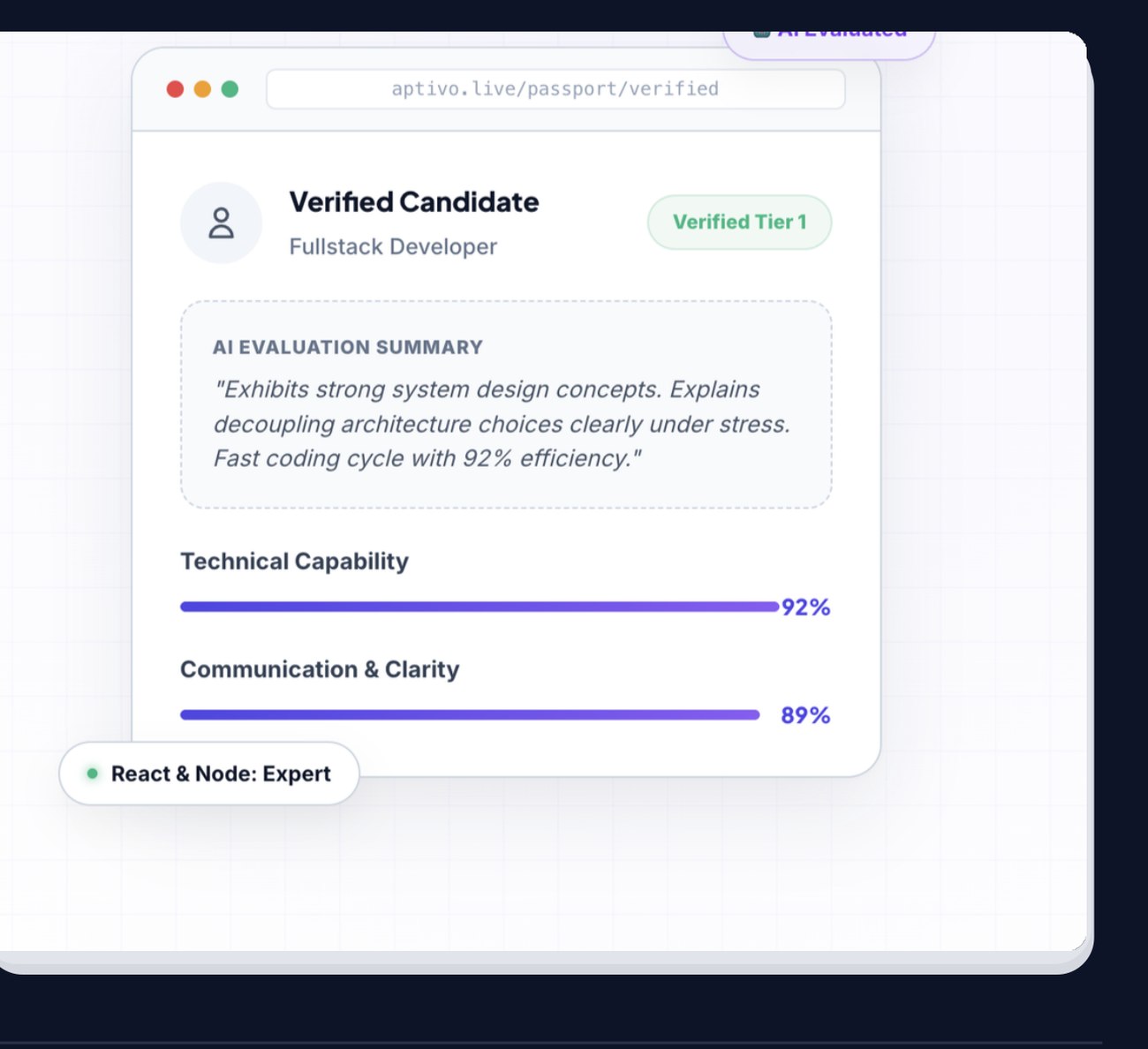
The AI conducts and scores the interview, so the result is consistent, objective, and verifiable — not just another opinion.
- AI-run voice interview
- Objective, consistent score
- Verified Talent Passport
Where this started.
I lived the candidate problem, and looked hard at the recruiter side — the gap between them became the idea.
My own search
Prep felt endless, and nothing proved I had actually improved.
The recruiter side
Recruiters face piles of look-alike CVs with no real signal.
The gap
Practice and hiring never connect — effort never becomes proof.
Two people to serve.
A candidate who needs proof, and a recruiter who needs signal — the product has to satisfy both.
The Candidate
Job-seeker · Early Career · Primary
Goal
Turn interview practice into an actual offer.
Frustration
Rehearses endlessly, but nothing proves she has improved.
The Recruiter
Agency / In-house Hiring · Secondary
Goal
Find genuinely capable candidates without wading through CVs.
Frustration
Piles of look-alike resumes with no real signal of skill.
One home, clear branches.
I sorted every function into groups that follow the candidate’s journey — those clusters became the sitemap: a single dashboard hub with shallow, predictable branches.
Set Up
- CV
- Role
- Timing
Interview
- Voice
- Transcript
Report
- Score
- Q-by-Q
- Passport
Placement
- Send to recruiters
Account
- History
- Pricing
The candidate’s path.
From set-up to the score that decides whether the report goes straight to recruiters.
- Set up
- Interview
- Report
- Score high? → Sent to recruiters
- Score low? → Practice again
Boxes before beauty.
I blocked out the main screens in low-fidelity first, so the structure was right before any styling.
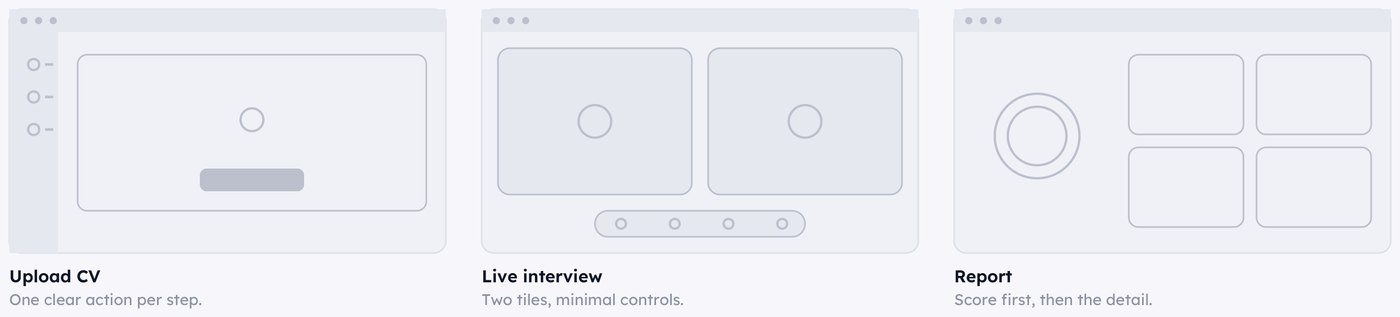
Key calls, and why.
Three choices that came from protecting trust and lowering the barrier to starting.
Passwordless email sign-in
Instead of passwords and accounts. Kills friction at the very first step — nobody bounces on a signup wall.
A free 8-minute warm-up
Instead of a paywall before value. Lets people feel a real interview before asking them to pay.
Honest, critical scoring
Instead of flattering feedback. A score recruiters believe is worth more than one that feels nice.
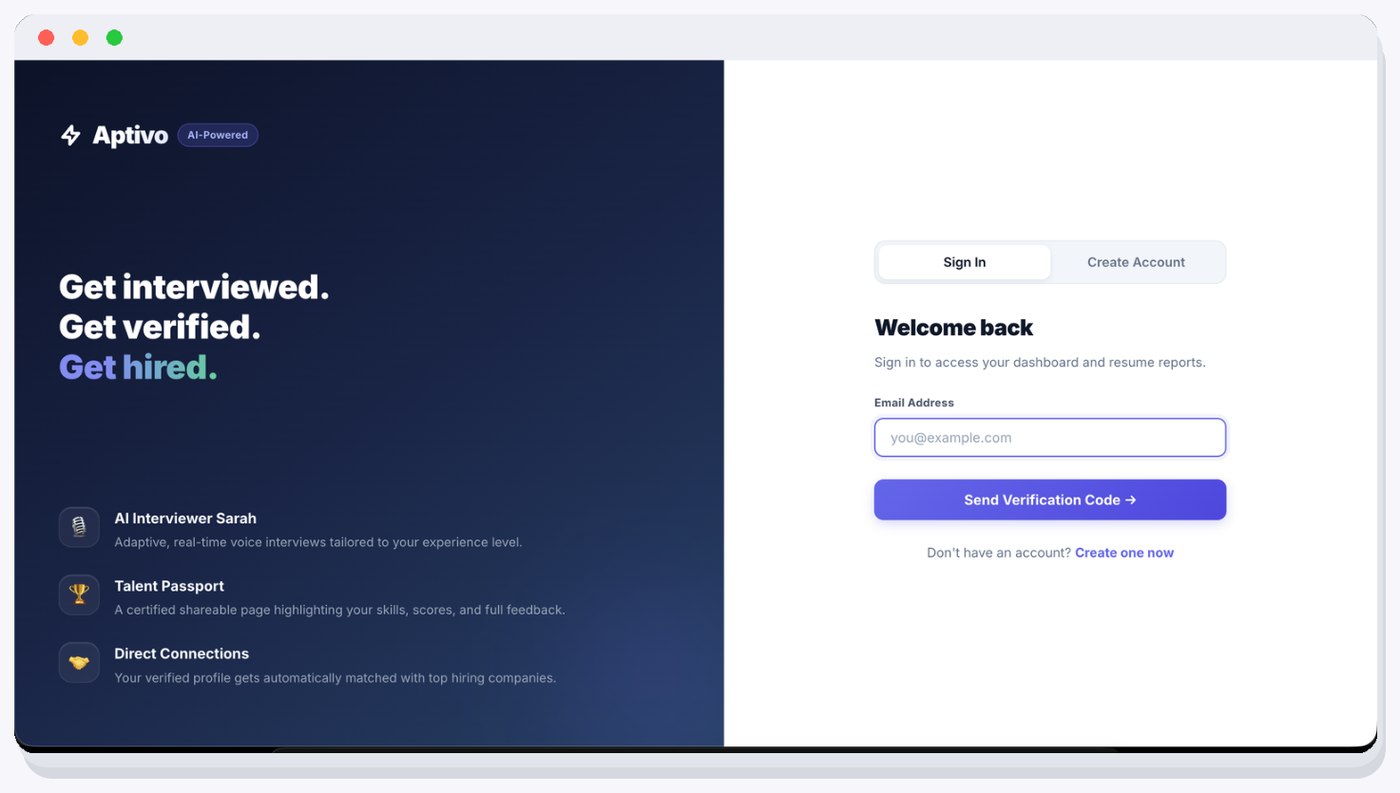
Passwordless by design.
No passwords to forget. You enter your email, get a code, and you’re in — with the three core promises right beside the form.
- Email code sign-in — no passwords.
- Sarah, the AI interviewer.
- Talent Passport + direct recruiter matches.
Your interview cockpit.
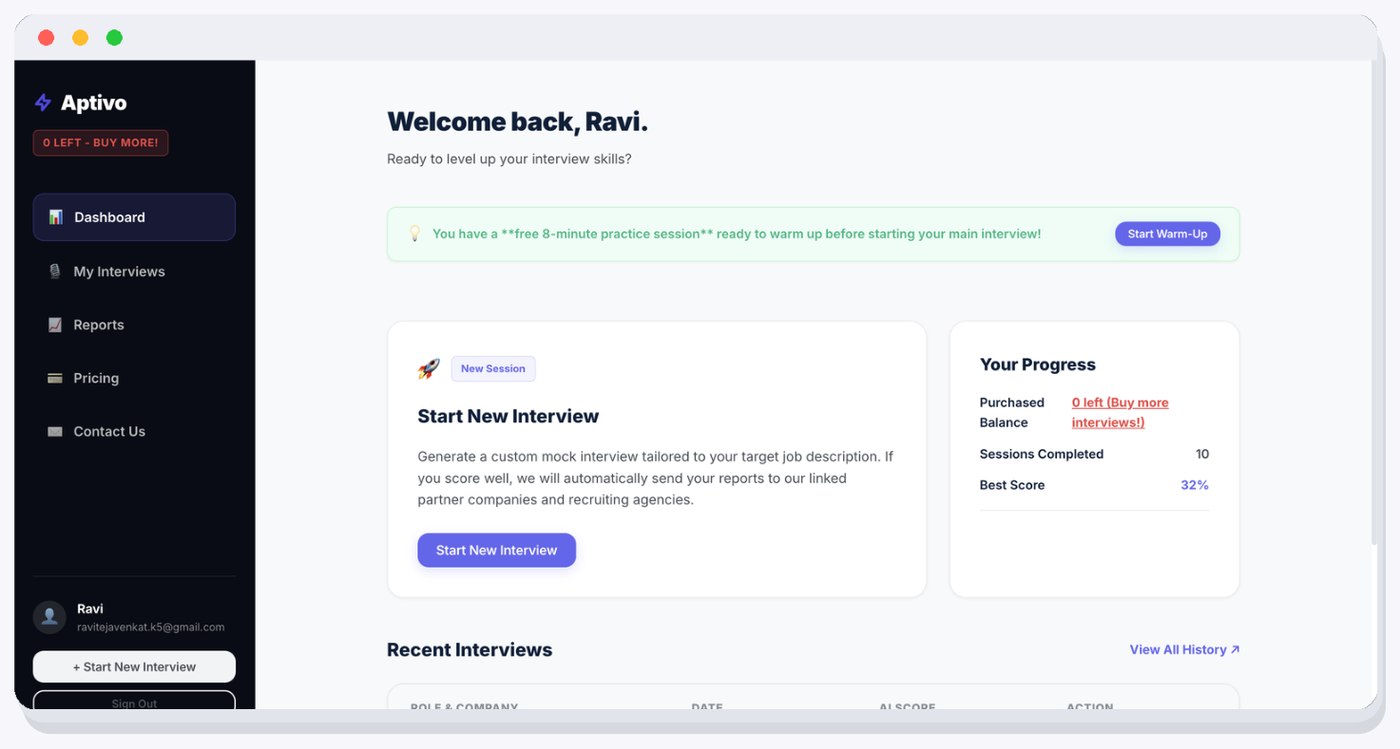
The dashboard is home. It greets you, nudges a free warm-up, and keeps your progress and credits in view.
- Free 8-minute warm-up to start.
- Progress: sessions done, best score.
- Credit balance always visible.
- One tap to start a new interview.
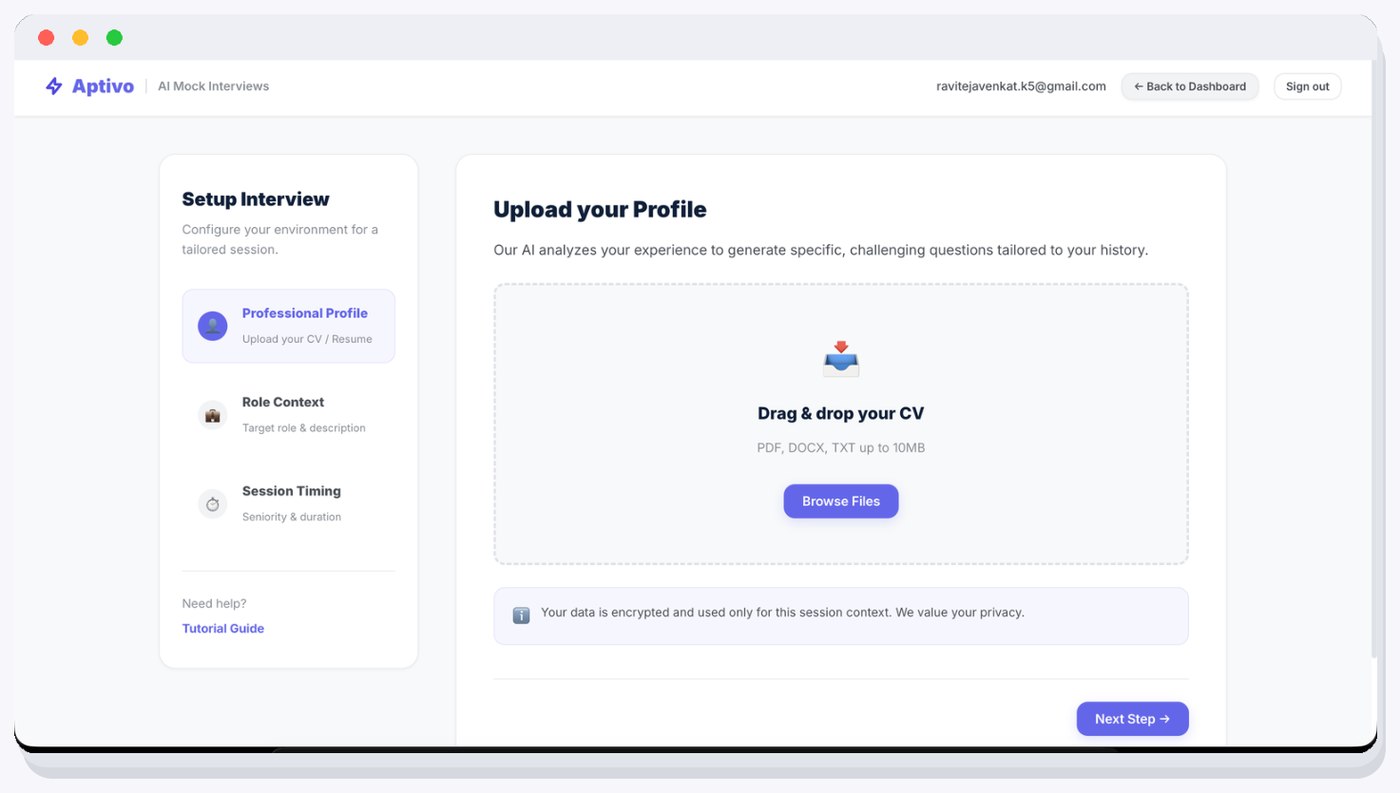
Upload, target, tune.
Three short steps configure the session: drop in a CV so questions are specific to real history, tell it the target role, then pick the mode, seniority, and length — with an 8-minute warm-up free.
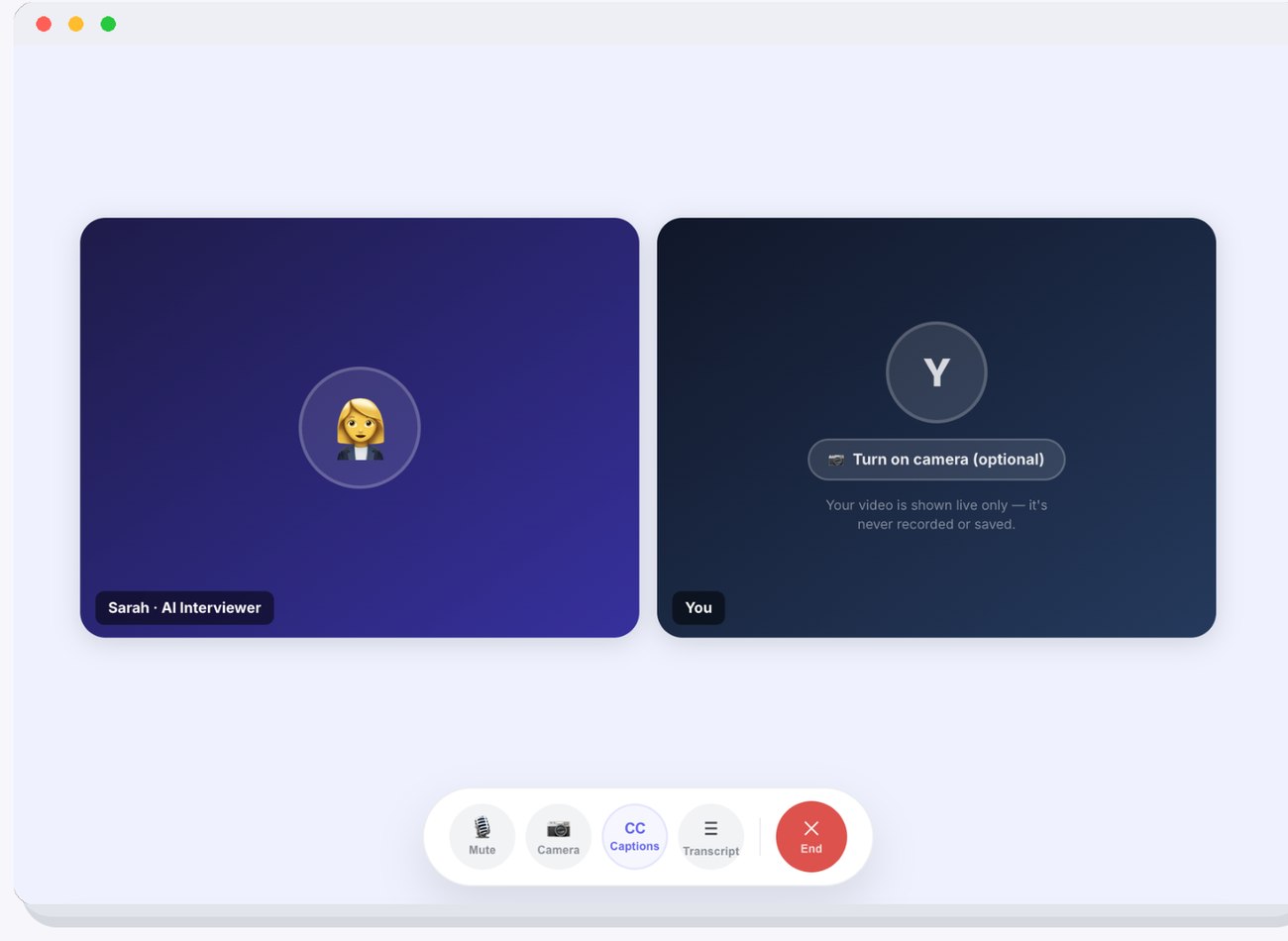
Meet Sarah, live.
The core moment: a real-time voice interview with Sarah, the AI interviewer. It feels like a video call, with captions and a transcript.
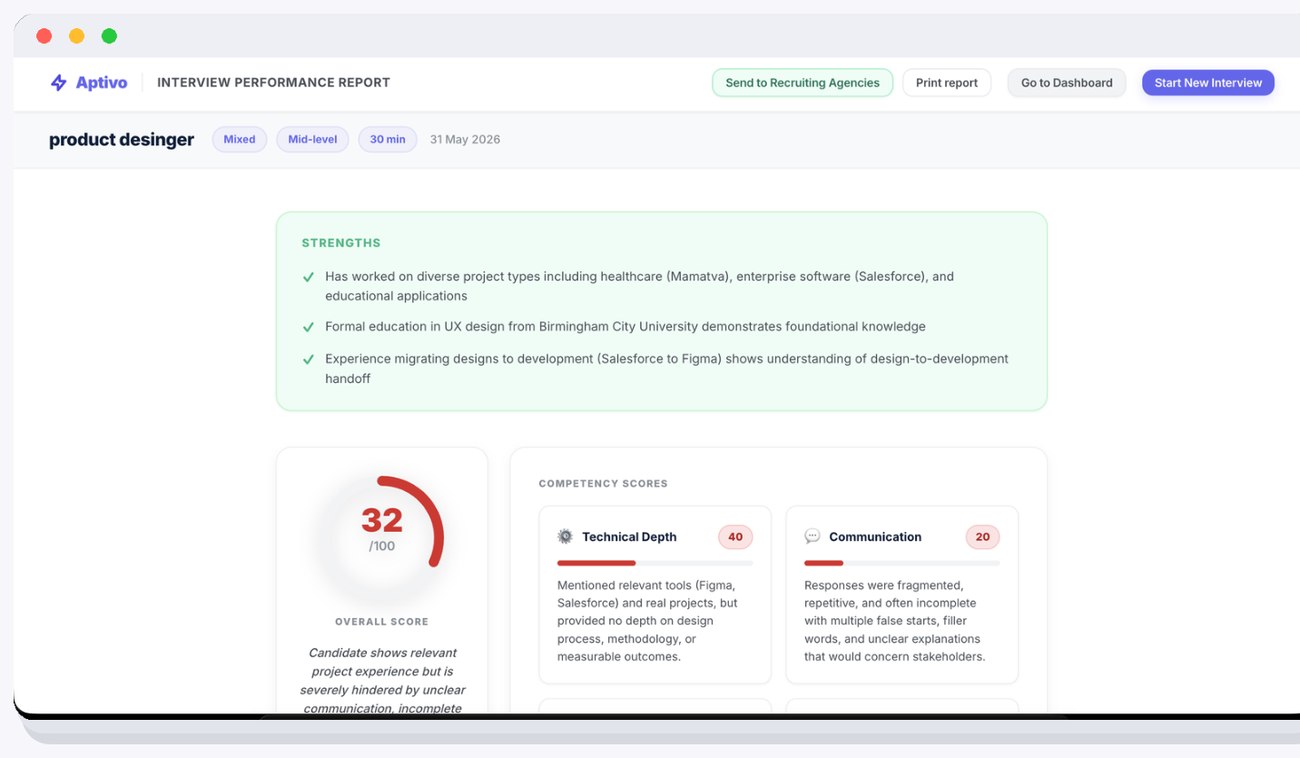
Honest, structured scoring.
When it ends, you get a real report — an overall score, competency breakdown, and clear strengths. It doesn’t flatter.
From report to recruiter.
This is where it pays off. A strong report becomes a verified Talent Passport — and the model lines everyone up behind the same outcome.
- Candidate takes the free AI voice interview
- Verified Talent Passport goes to hiring partners
- Recruiter fast-tracks the hire
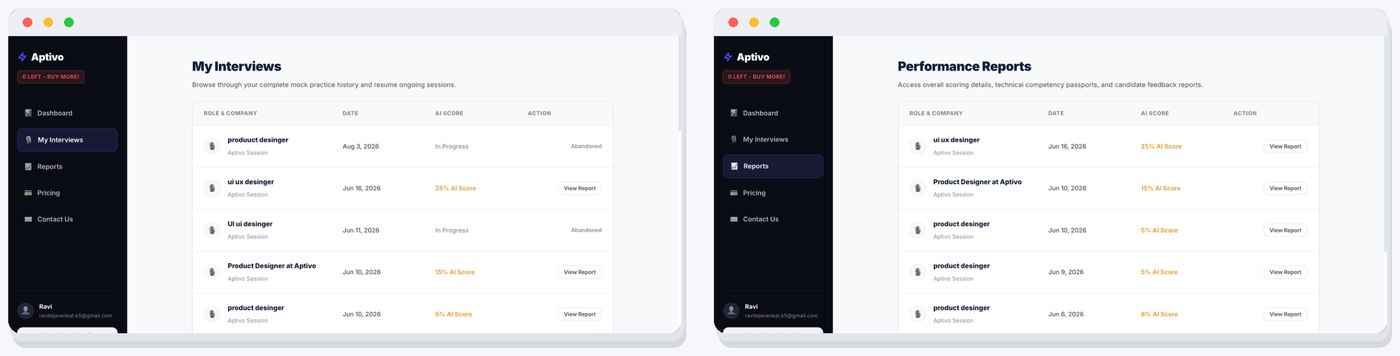
Every session, saved and scored.
Two history views keep the whole journey in one place — sessions to resume, and reports to reopen or resend.
What real use fixed.
Iterating on the live flow — I watched where it broke or confused people, and fixed those spots.
Observed
The interview stalled when a candidate went quiet for a while.
Changed: Added a silence check-in so Sarah prompts gently and keeps going.
Observed
People got lost in the hand-off from set-up into the live interview.
Changed: Tightened the flow so set-up leads straight into the call.
Observed
The report’s low scores felt harsh without any context.
Changed: Reframed scoring as honest and specific, with strengths called out too.
One calm system, built to ship.
A dark-first system, one indigo accent, consistent components — designed in Figma and shipped live with AI-assisted tools.
Lexend
Friendly, highly legible — chosen for a form people fill out under pressure.
Live, early, and mine end to end.
Aptivo is live and in early traction. I’m honest that the recruiter side is still being built out.
18+
professionals hired (per site)
Live
shipped at aptivo.live
1
designer-builder, end to end
1 · I own the full loop
Idea to shipped build — no hand-offs between design and engineering.
2 · The flow was the problem
Not any single screen — getting candidate and recruiter to trust the same score.
3 · Honest design earns trust
A critical score that feels fair is worth more than one that feels nice.
Thank you.
Practice interviews that get you placed.